|
| Chanson
française |
A good way to understand
a people is to listen to its music. French songs have a special
flavour, a very sentimental tone, the lyrics are more
important than the music. Very often they are based on a
triple time rhythm and use instruments like the accordeon. |
|
|
|
|
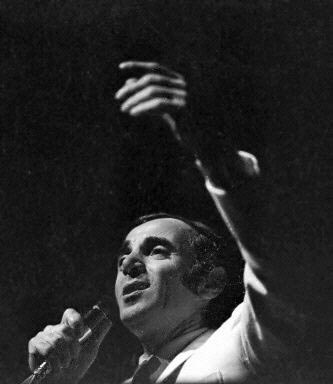 Charles Aznavour, elected "Entertainer
of the Century" by CNN and Time (2000, before Sinatra, Prestley and Dylan ! ) died Oct.2018 (credit) Charles Aznavour, elected "Entertainer
of the Century" by CNN and Time (2000, before Sinatra, Prestley and Dylan ! ) died Oct.2018 (credit) |
| Some facts about French
songs |
|
French songs today |
- Among the most
popular French songs
- Among the most successful French songs in English version
- Autumn Leaves by Frank Sinatra (from Les Feuilles
Mortes, by Yves Montand) (listen to it)
- My Way by Franck Sinatra (from Comme d'habitude by
Claude François)
- Born to be alive by Patrick Hernandez
- More to come
- Multi-ethnic : reflecting French society, French songs are
very open to foreign cultures and the most popular singers include
MC Solaar (black rap), Zebda group (arab), Khaled (arab), etc...
The future of French songs is clearly ethnic, at
the image of the country.
- The most famous French DJ, David Guetta has sold over 40 million records worldwide.
- Singers who have had a major influence on French songs include
:
- Charles Trenet (1940s-1960s), nicknamed "le fou
chantant" ("the singing crazy man") : poetry, cheerfulness,
jazz ...
| Georges
Brassens (1950s-1970s),
representative of the "chanson d'auteur" ("author's
song", i.e.where the lyrics are essential or "chanson
Rive Gauche" i.e. |
| who performed in cabarets on the Left
Bank in Paris) : poetry, humor, provocation ; he was considered
a master by such great singers as Jacques Brel, Leo Ferré (listen to one of his great songs),
Guy Béart, Barbara (listen to one of her great songs), Claude Nougaro, Jacques Douai ("the French Pete Seeger"), etc... |
 (credit) (credit)
listen to one of his most beautiful songs ! |
- Charles
Aznavour (1960s-1990s),
is a great showman (listen to one of his most beautiful songs !) like Edith Piaf, Maurice Chevalier, Michel
Sardou, Johnny Hallyday (the most popular French singer from the 1960s to his death in 2017), etc...
- Serge Gainsbourg (1960s-1980s), an excellent musician, creative
and open to all forms of music influenced many of the younger
French singers such as Jean Jacques Goldman, Benjamin Biolay,
Sanseverino,...
- The rock group Noir Désir
in the late 1990s and Alain Bashung
- More to come.... Other names
suggested by visitors include William Sheller, Mylene Farmer,
etc...
- Click here and listen to my 10 favourite French songs
DO
YOU KNOW JOHNNY HALLYDAY ? He died in December 2017. Very few Americans knew him and all of those who did mocked him and looked at him with scorn. Why? The 74-year old rock singer was among the most popular French singers but it is understandable that for most Americans, the words a "French rock singer" may sound as unexpected as "an English chef". However, Johnny was clearly a national monument and hundred of thousands of fans, including the President of France, attended his funeral. |
|
French music is alive and well
! Young groups and French singers keep the tradition of French
songs (the importance of lyrics) associated with a new form of
music (integrating an African or Arab sound). Among them :
- French Rap Music is very
popular, with groups like NTM or singers like Diam's or MC Solaar.
Diam's is France's most popular female rapper. Born in
Cyprus and raised in a Paris suburb, Diam's is part of a new
generation of French singers with immigrant roots. In her hit
song, "Ma France à moi" Diam's, who wears baggy
pants and keeps her hair cut very short, captures the feelings
of the disaffected youth who don't relate to traditional France.
- French Rock & Roll
with Indochine, les Rita Mitsuko, Noir Désir or Mano Negra
(with Manu Chao, who now sings alone)
- World Music, with singers like Amadou et Mariam
- Popular singers include
Raphael, Cali, Sanseverino, Benabar, etc
- An example of the merging of
tradition with new forms is the singer (of Arab origin) Rachid
Taha singing with his group "Carte de Séjour (Green
Card) the old (1943) Charles Trenet standard " Douce France
"
- In
Québec, they love songs and they have great singers.
Among them, Félix Leclerc, a kind of founding father figure,
Gilles Vignault, Robert Charlebois, Richard Desjardins, etc...
and many more. If you love songs in French, when in Montréal
or Québec, spend an evening in a "boite à
chansons" (a "café" with singers)
- More to come...
The "new France" resulting
from immigration
is not only represented by suburban riots. Thanks to ethnic diversity,
there is an incredibly rich new generation of young singers,
movie-makers and
writers
. Rap star MC Solaar (credit) Rap star MC Solaar (credit)
French music and the "exception culturelle francaise" France is the only country in Europe where national music is
predominant (2/3 of the number of records sold). Why ?
- a quota policy : minimum 40% of French music on radio
channels (see the site of the French regulator - CSA - and
comments about the Sept.30, 1986 Law creating quotas : 25% or
60% for stations with a particular broadcasting policy regarding
creation, 40% as a standard rule)
- a huge heritage of great singers (Piaf, Brel, Brassens,
Aznavour, etc...)
- excellent concert halls and numerous Summer
festivals
|
|
--> In 2004, the Bibliothèque
Nationale de France organized an (excellent) exhibition called
"One Hundred Years of French
Songs". Each decade
was illustrated by the 10 "best" songs of this period.
Among them, I have selected the following :
- 1900-1914 ("Caf'conc' et
Cabaret") : Sous les ponts de Paris (1913) by Georgel
: cabaret songs, often saucy, popular entertainment, ...
- 1914-1918 ("Chansons dans
la guerre") : Quand Madelon (1914) by Bach : patriotic
songs,...
- 1918-1930 ("les années
folles") : J'ai deux amours, mon Pays et Paris (1930)
by Josephine Baker (listen to it) : love and glamour in 1920s Paris, discovering jazz, ..
- 1930-1939 ("de l'euphorie
à la débâcle") : Parlez moi d'amour
(1930) by Lucienne Boyer : "chanson réaliste"
(very depressing...) or very sentimental,.. (listen to it)
- 1939-1945 ("chansons sous
l'Occupation") : Douce France (1942) by Charles Trenet
: nostalgia,...
- 1945-1960 ("de Saint-Germain-des-Prés
à la Nouvelle Vague") : Hymne à l'amour
(1950) by Edith Piaf (listen to it)
- 1960-1970 ("génération
Yé-Yé") : Ma plus belle histoire d'amour
(1966) by Barbara : at the same time, discovering rock'roll
(Johnny Hallyday etc..)
and the top moment of "chanson d'auteur"...
- 1970-1980 ("engagement
ou divertissement") : C'est extra (1969) by Leo Ferré
: following the student's revolt of 1968, a period of politically
engaged songs,...
- 1980-1990 ("le temps des
groupes") : Un autre monde (1984) by Telephone :
the music isd more important than the lyrics ; big concerts...
- 1990-2004 ("rap et musiques
plurielles") : Aïcha (1996) by Khaled (listen to it) and many young
singers, often from African or North-African origin, introduce
a new form of songs,...
--> Children songs include : Au clair de la lune
(see below), Le Bon Roi Dagobert, Cadet-Rousselle, Frère
Jacques, Sur le Pont d'Avignon, etc...(everybody knows them...)
|
|
USEFUL TIPS..The
radio station for Rap and Rock & Roll is Skyrock (96Mhz)
and if you want to know where to go to listen to music, from
the smallest cafés (with an unknown group of singers performing)
to the largest concert hall, read LYLO (" les yeux
les oreilles " : i.e. Eyes and Ears, bi-monthly, more than
1000 concerts in hundreds of places n Paris for the coming 3
weeks) : you can find it (for free) in most musical bars and
concert places in Paris
Famous French songs about
Paris
Paris has always been a source
of inspiration for poets and singers and some of the most popular
French songs are about Paris.
Months
in Paris
- April in Paris
- J'aime Paris au Mois de Mai : Charles Aznavour
- Le temps des Cerises (JB.Clement,
Renard): Yves Montand
- Paris au mois d'Aout : Charles Aznavour
- September in Paris
Love
in Paris
- J'ai
deux amours, mon pays et Paris
(1931, Scotto, Koger, Varna), Josephine Baker
(listen to it)
- Vous qui passez sans me voir (1936, Hess, Trenet), Jean Sablon (listen to it)
- Parlez moi d'amour (1930, Jean Lenoir), Lucienne Boyer
- More to come
. An
authoritative book on French songs about Paris (Editions Aumage,
Paris, 2005) (credit) An
authoritative book on French songs about Paris (Editions Aumage,
Paris, 2005) (credit)
|
|
DID
YOU KNOW THAT ...... ? If a French person can sing ONE song or play
ONE tune, he/she will sing " Au Clair de la Lune
". The words are "Au clair de la lune, mon ami Pierrot,
prête moi ta plume pour écrire un mot.....etc"
i.e. " My friend Pierrot, under the moonlight, please loan
me your goose quill : I want to write something" (it's more
poetic in French !) and the tune goes like this.
USEFUL
TIPS......Every
year, since 1976 the Mecca of French songs is the Festival
de Bourges (in the center of France) in April. Very popular
French singers include Francis Cabrel, Jean Jacques Goldman and
the most promising young French singers seem to be Vincent Delerm,
Mathieu Chedid, Benabar, Sanseverino, Thomas Fersen. Another
very interesting Summer festival devoted to French singers is
the "Francofolies de la Rochelle" (in July).
More about festivals.
|
|
Places in Paris
- Montmartre : La Bohème (1966, J.Plante,
C.Aznavour), Charles Aznavour, enregistré en public Janvier
1978 (1998 EMI Music)
- Saint Germain des Prés : A Saint Germain des Prés,
Leo Ferré, enregistré en public en 1969 (Meridian)
- Les Boulevards : J'aime flaner sur les grands boulevards,
Yves Montand
- Les prénoms de
Paris : (J.Brel, G.Jouhannest), Jacques Brel,
1972 (Polygram)
- Old Paris : Rouge Gorge (R.Séchan),
Renaud (1988 Virgin France)
- Bistrots : le vieux bistrot (G.Brassens)
- Menilmontant (Charles Trenet, 1939)
- Pigalle (Maurice Chevalier)
- Paris : A Paris (Francis Lemarque, probably the
most popular song about Paris, for the French)
or Un gamin de Paris
(Yves Montand) and also Revoir Paris (Charles Trenet, 1947)
- More to come...
|
| Lyrics of French songs |
|
Places and sites to find French music and lyrics |
| Visit the sites of
the singers with their biography, discography and the lyrics
of their songs : |
|
Sites
to visit
To order lyrics
online : Paul-Beuscher
has a huge catalog.
|
|
Websites
:
- Visit a remarkable site, with more than 350 old French songs (but of course you have to know the name of the song)
|
 |
Books
:
- One of the best books on the
history of French songs is : Claude DUNETON, Histoire de la
chanson française (2 vol.), Seuil, 1998
|
|
Places to shop in Paris
- FNAC : several large stores : 24 Bld des Italiens 75009 Paris,
136 rue de Rennes 75006 Paris, 74 av. des Champs Elysées 75008 Paris,
109 rue Saint Lazare 75009 Paris, etc...
- Paul Beuscher : 27 bld Beaumarchais 75004 Paris
- Many "passages"
(XIXth Century commercial malls) include one or several shops with
old musical scores (Passage Jouffroy, Passage Verdeau, Passage
Vivienne, Passage des Panoramas, etc...)
- More to come
DID YOU KNOW
THAT.....? On French TV and radios and in CDs, there is of course
a very fierce competition with American singers. Here
are the figures for 2003 : French songs represent 22% of the
market on radios, 60% of CDs sold. This is considered a relatively
improved situation. Read about the "exception
culturelle".
|
- Jazz is alive and well in Paris : see where.
- This page is still under construction
: please write
to me to help to improve it.
DID YOU KNOW
THAT ? When you learn music in France (and in other Latin countries),
you don't call the notes " A, B, C, D, E, F and G "
but " do, ré, mi, fa, sol, la and si".
|
|
|
| To related pages : Listen to my favourite French songs, regional and ethnic French songs, see pages on French culture, French movies, French literature, unknown Paris, intercultural differences, try my French Quiz, etc... |
|
To table
of contents
To top of the
page
Back to home
page
|
Harriet Welty
Rochefort writes articles and books about France and the French.
Order her books:
- "Joie de Vivre", Secrets of Wining, Dining and Romancing like the French, St.Martin's Press, New York, 2012
- "French Toast, An American in Paris
Celebrates The Maddening Mysteries of the French", St.Martin's Press,
New York, 1999
- "French Fried, The Culinary Capers
of An American in Paris", St.Martin's Press, New York, 2001
More on Harriet's books (excerpts, upcoming
events, testimonials, etc..)
|
| To
email
me |
This page is one of the 10 most visited pages of the site. If you like this site, please bookmark it or create a link. |
|