-
The Place de la Concorde,
where King Louis XVI was beheaded
in 1793 ; the exact place is near the big lamp-post representing
the city of Strasbourg, facing the Hotel de Crillon.
-
Other places associated with
the memory of various revolutionary events in Paris (more
about revolutions in Paris) include the Mur des Fédérés,
in the Père Lachaise Cemetery (where hundreds of insurgents
were shot in 1871), the Boulevard Saint Michel in the
Latin Quarter (imagine it with tens of barricades in 1968), etc
; you may also notice thousands of little marble slabs on the
wall with a name on them and a date in the third week of August 1944
: they refer to the upheaval of Paris before its liberation by
the Allied Armies in August 1944.
-
When you visit the delightful
garden of Palais Royal imagine it in the XVIIIth century,
with " jet-set " gamblers and prostitutes and, later
on, Revolutionary orators such as Camille Desmoulins who started
the Revolution there.
-
On August 24, 1944, between
the Notre Dame Cathedral and the Prefecture de Police
(the building facing it), two German armoured tanks were ready
to fire at the insurgents in the Prefecture when they were destroyed
by young resistants hidden behind the big statue of Charlemagne
nearby.
-
There are also many historical
American landmarks in Paris : read about some of them.
- More to come (for more information
: read Thirza Valois's
books or travel
in France)
USEFUL TIPS.....Understanding
the French Revolution, with three remarkable movies : "La
Révolution Française" (Part 1 : "Les
Années Lumières", Part 2 : "Les Années
Terribles"), directed by Alexandre Mnouchkine, sponsored
by the French Government as an educational film for the Bicentenial,
very spectacular, accurate and definitely fascinating ; and also
"Ridicule", a brilliant picture of life of the dying
world at the court of Louis XVI.Click here for more films.
DID YOU KNOW THAT . . . ? Like an onion, Paris has several layers. All around the city of Paris, there are three very visible rings. The first one is a large avenue, the Boulevard des Marechaux (Marshals Avenue), where each section bears the name of one of the 26 marshals of Napoleon's Empire. A few hundred yards further away is the Boulevard Peripherique, a large expressway all around the city. In between, the large ring is filled with hundreds of 6-story brick buildings. They are all public housing (HBM now HLM), constructed in the 1920s on the place of the fortifications, built by Prime Minister Thiers in the 1840s to protect Paris in case of siege. They proved inefficient in 1870 when Partis was besieged! They were the fourth rings of fortifications in the history of Paris : the Roman wall (nothing left), the medieval wall "enceinte de Philippe Auguste" (with some impressive remains in the Latin Quarter and the Halles) and the 18th century "enceinte des fermiers generaux" (with a few remains like Porte Saint Denis or Porte Saint Martin).
A few good books :
- Anthony SUTCLIFFE, Paris, an architectural history, Yale Univ. Press, 1993
- Claude MIGNOT, Grammaire des immeubles parisiens, Parigramme, 2004
- Hervé MARTIN, Guide to modern architecture inParis (bilingual), Alternatives, 1990
|
|
Paris is not a dead museum and
over centuries, each period has contributed to the variety of
buildings. However, some areas have the flavour of a particular
time. For instance :
-
IInd century : the Roman baths,
adjacent to the Cluny (XVth Century) museum, are quite impressive
; around it, visit an interesting "medieval garden".
-
XIIth-XIIIth century : Medieval Paris,
with Notre-Dame cathedral (devastated by a fire in April 2019), the Sainte Chapelle, the Basilique Royale (in Saint Denis), the Bernardins Cloister, etc...
-
XVIth century : visit the Marais
and all its mansions
(Carnavalet, the historical museum of Paris, for example, but
the whole area has tens of them)
-
XVIIth century : Place des Vosges
is a remarkable example of urban harmony and many monuments in
Paris illustrate this period (the Invalides etc)
-
XVIIIth century : Parc Monceau
and the buildings around it, including the wonderfully furnished
Musée Nissim de Camondo
-
XIXth century is the Golden
Age of embellishment of the city ; the illustrious prefect Haussmann created
the large avenues, the style of buildings (light brown-yellow
stone and slate roofs) leaving room for major monuments such
as the (old) Opera House and large parks (Bois de Boulogne, Bois
de Vincennes and, less known, the Parc des Buttes Chaumont) and
of course the Eiffel Tower
-
1900s : in addition to the Grand
Palais, the Galeries Lafayette and the Metro
entrances, do not miss
Art-Nouveau buildings such as 29 Avenue Rapp
-
1930s : the Trocadero Palace
(facing the Eiffel Tower), the (former) Museum of Colonies (Porte
Dorée) now Museum of Immigration
-
1960s : everything from ugly
(Front de Seine) to barely acceptable (La
Défense)
-
1970s : under Mitterrand's presidency,
several " Grands Projets ", ranging from interesting (la
Grande Arche de la Défense) to abominable (the new Opera
house in Bastille) or ridiculous (the Bibliothèque Nationale)
: read my page about the ugliest buildings in Paris
-
1990s : building illustrating
the necessity of an opening to the
world (Institut du Monde
Arabe, near Notre Dame and Musée du Quai Branly near Eiffel
Tower)
-
2000s : the future of Paris
will probably be in the East or North-East :
around the Bassin de la Villette and the Parc de Bercy
-
2020s : later towards Aubervilliers
and the Canal de l'Ourcq ? Boulogne-Billancourt on the island
where the Renault plant was ? You'll have to come back !
More in Paris
Notebook. Getting mixed up ? Read about French
kings
and see the main differences in style in furniture and construction ; read about the ugliest buildings in Paris.
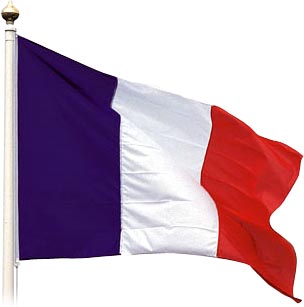
DID YOU KNOW THAT .....? The French flag is blue-white-red thanks to La Fayette ! In his efforts to reconciliate
the French monarchy with the Revolution after the storming of
the Bastille, he proposed to associate the colors of Paris, traditionaly
blue and red, to the color of the monarchy, traditionaly white.
With the white between the blue and the red, the flag illustrated
the monarchy controled by the Revolution. |
 See
See