|
| Some political issues in France .... |
|
Some facts about politics
in France |
WARNING! In this page, I try to list some of the key issues, in French political life. Maybe I'm wrong, maybe I'm prejudiced : it is only my opinion!
 |
|
DID YOU KNOW THAT....? People who support the Left Wing and radical ideas although they are very well-off, and sometimes billionaires, are called the "Gauche Caviar" (caviar left).Typical members of it are the late Pierre Bergé (who owned Saint-Laurent), Bernard-Henry Lévy, Philippe Sollers, and many others.
French polical forces
-
In France, political forces are not extremely different from what they are in other European countries but there are three important national specificities, all grounded in history. The first on is the importance of Marxist philosophy on the whole French political Left, the second is the quasi-absence of any political expression of religion (see : laicité) and the third is the large agreement on the necessary role of the State, both on the Left and on the Right (see : Bonapartisme).
-
Political forces are rather stable over a long period of time, although they take different names.
- For decades, the situations was as follows :
- On the Extreme Left, a few extremist parties : Lutte Ouvrière (Olivier Besancenot), Ligue Communiste Révolutionnaire (see : Trotskism), getting a few % each
- On the Extreme Right, a (growing from 3% a generation to 25/30% today) populist party, the Front National (Marine Le Pen, the daughter of the founder)
- On the Left, a strong Communist Party (10/15%) and a Socialist Party (15/25%) which does not dare to do what other European Socialist Parties did when they openly abandonned any Marxist reference and called themselves Social-Democrats (François Hollande, Martine Aubry, SegoleneRoyal, Dominique Strauss-Kahn,..).
- one or several Ecologist parties (5 to 15%), today Europe Ecologie-Les Verts (Daniel Cohn-Bendit)
- one or several Center parties (5 to 15%), today Modem (François Bayrou)
- an important Center Right party (15 to 25%), today Les Républicains (President Laurent Wauquiez, yesterday Nicolas Sarkozy)
-
Globally, the Left and the Right are close : the Left+Extreme Left and the Right and Extreme Right represents each around 50% of the vote and the results of national votes are always almost 50/50 (according to the French Constitution, only two candidates may run on the second round of Presidential elections)
- See the results of the 2012 Presidential elections, with the score and the mottos of the 10 candidates (and the most incredibles promises and statements...)
- The 2014 local and European elections were a huge success for the Extreme-Right Front National party whose score (around 30%) was close and often ahead of the two major parties (Socialist and UMP). Is this the end of the two-parties system mentioned above? It is not sure and its voters are not the traditional Extreme-Right voters (maybe 5%) but mostly people in despair, young or coming from the Left (most of former Communist voters voted Front National). In France, the total failure of the Socialist government of Holland explains a large parti of this phenomenon. Read the history of Extreme Right in France and see about other European countries.
- Read my column about François Hollande "A quintessential Frenchman"
- The French are not happy with their political life and the situation has changed dramatically in 2017
- Emmanuel Macron, an outsider, was elected president and his voters came from the Center, the Socialist Party and the Right. He created a party (La Republique en Marche-LREM)
- The Extreme Right Rassemblement National challenges LREM, each of them representing around 30% of the vote
- The Socialist Party practically disappeared (a few % only) and the Right lost half of his voters
- The Communist Party pratically disappeared and small extremists parties too and a strong revolutionnary party (La France Insoumise, led by Jean-Luc Melenchon) represents now 10 to 15+ % of the voters)
- Several Ecologist parties represent 10/15% too.
- In 2018, the Yellow Vests movement created a new context : no leader, no program, no party (but an obvious proximity with the populist Extreme Right), violent demonstrations all over the country at least once a week. Except the Rassemblement National, the Yellow Vests tetanize all political parties.
- More to come.....
The French Constitution
-
The French Republic has had several constitutions (some say : too many) since 1792, when monarchy was abolished (in fact, France had two emperors and three kings after this date...) ;
-
The (current) French Constitutio, the thirteenth, was designed under General de Gaulle, after he was elected President of France in 1959 ; the major changes were the election of the president by all the French citizens (and not any more by a limited electoral body) and a majority vote for parliament which, practically, forces to bipartism ;
-
Its objectives were to reduce the power of the Parliament and the influence of political parties and give more responsibility to the Head of State (under the previous regime, the president had practically no power) ; what the French call the domaine reserve of the president refers to the domain where his responsibility is unquestionable (typically: diplomacy);
- More to come...
DID YOU KNOW THAT .... ? The origin of the words "Left" and "Right" in politics goes back to September 1789, shortly after the storming of the Bastille, when the Constituent Assembly met in Versailles to vote about the key question : "Could the King veto a law?". The president of the assembly, Clermont-Tonnerre, asked the deputies who were against the veto to sit at his left, while the others would remain at his right.
French think-tanks
The most influential French think-tanks are :
- Institut Montaigne (created 2000), close to the big business
- Terra Nova (2008), close to the Socialist Party
- Fondation pour la Recherche sur les Administrations et les Politiques Publiques-IFRAP (1985), focused on improving the efficience of the State
- Institut Français des Relations Internationales-IFRI (1970), more academic
- and many others.
There is an "observatory of Think-Tanks" which follows and comments their actions and publications |
|
-
According to its constitution (Article 1) "La France est une république indivisible,
laïque, démocratique et sociale" (France
is a republic, indivisible, secular, democratic and social).
-
The major
national parties are
: PS (Socialist Party), Les Republicains (Right Wing), the Center under various names now En Marche! (around Emmanuel Macron in 2017) ,
Front National (Extreme Right National Front), an alliance of Extreme Left (including Communist,
Ecologists). Each of them counts between 15 and 25% of the votes. With non-voters (around 20%), it shows a country divided into 5 parts, strongly opposed and almost equal (there are also a few small parties like CNPT Chasse-Pêche-Nature et Tradition,
the party of people who oppose European regulation on hunting
etc...). Read about the financing of political parties in France. Read more about French political forces and see a page on the 2017 presidential election.
-
As in most democratic countries the political power is represented by a majority and an opposition which represent almost the same proportion of voters (a score of 55% is a landslide) : they are identified as "gauche" (left wing) and "droite" (right wing). The steady growth of the Front National (extreme Right) is a major trouble to the old bipartyisan game. Local elections are important, and do not always give the majority to the same party as the national elections do.
-
France has the highest number of local authorities in Europe (more than 36,000, not including the
structures they form between themselves) and therefore has a
very active local political life with more than 500,000 elected
officials. Of course, local communities are small and therefore
the political system is very centralized with a strong central
state but one can say that the local authority and its city council
are the core of French democracy. In a city or a village, whatever
its size, the mayor is always the most important political figure.
Read more about the various
layers of structure between the citizen and the State.
-
In France, unlike the USA, the
majority of national politicians are civil
servants (often high-ranking)
; the majority of the cabinet members and a very large number
of parliament members graduated from the same prestigious school
: Ecole Nationale d'Administration (ENA).
In 2007, it was considered very unusual when the elected President was
not. It is not exaggerated to say that they are often cut off
from real life : read about the 2005
strikes and more about their ignorance of private business.
-
Women are heavily under-represented in French political life (maybe
this why it is so often ridiculous...) : see comparative
figures.
-
The French love politics and
they believe that the first thing you must do in a democracy
is to vote : voter participation is very high (almost 86% in the 2007 presidential election)
and they are shocked by the low figure in the USA. They believe
in what Pericles said : "a citizen who is not involved
in politics is not a quiet citzen, he is a useless citizen"
! Elections always take place on Sundays and (except for European
elections) are two-round elections.
- Political ethics : All the international comparative studies (International Social Survey Program or World Values Survey, for example) show the same differences between France and other comparable countries : less confidence in institutions, more understanding for the misbehavior of politicians, more indulgence for misuse of public money, etc. In a nutshell, they expect less from their democratic system and from their politicians than other countries. Cynicism, pessimism, negativism or realism ?
DID YOU KNOW
THAT.... Stanley Hoffmann has observed that France and the United
States are both nations that see themselves as having a universalizing, civilizing mission and this is one the reasons of their
rivalry (quoted by Timothy Garton Ash in an excellent article,
Anti-Europeanism in America, The New York Review, Feb. 13, 2003).
Mort Rosenblum gives a very good picture of this largely shared
French vision in "Mission to Civilize" .
In other European countries
WARNING! This page (still under construction) is not a study of the political situation of other countries. Its aims is only to underscore a few facts, well-known in Europe but maybe not everywhere else.
-
In Belgium,
- the major issue is to remain a country when it is so deeply split between two communities : in the North 6 million Flemish-speakers ("flamands"), in the South 4 million French-speakers ("wallons"), in between them, Brussels, de facto capital of Europe, with a population of 2 million, mostly French speakers.
-
When Belgium was created in 1830 (i.e. recently!), the "wallons" were rich, industrialized and had the political power on the "flamand"s, poor and rural. Now it is the opposite and the rich, developed, enterprising "flamands" are sick and tired of (as they say) paying for the welfare state of the less dynamic "wallons". They want to go from a federation (as of today) to a confederation of two states and, for some of them, toward an independant "Flandre".
-
In Spain
-
in spite of all the efforts made by the Spanish state to transfer its powers to regions at least two regions have a very strong independentist movement : Catalunia (speaking Catalan instead of Spanish is mandatory) and the Basque country (were the terrorist group ETA is still active)
-
Spain was a model for Europe : after 35 years of dictatorship, the "movida" of the 1970s made it one of the fastest-growing countries ; the 2009 crisis is hitting both the economy and the morale of Spaniards
- In Italy,
-
one of the main issues is to improve the quality and the efficiency of the State
-
another one is the North-South split, common to all European countries but certainly deeper in Italy and the LegaNord is a major party in Italy
The victory of an awkward populist alliance in Italy creates new tensions within the European Union
-
In the UK :
-
European or not ? The only thing to know is that UK does not believe in the future of Europe : its only policy is to take advantage of it and be ready for any other policy (as long as it is consistent with the US policy....)
-
regarding Europe, British policy has always been to prevent another country to dominate continental Europe (Spain with Philippe II, France with Napoleon or Germany with Guillaume II or Hitler) : the only reason UK joined the European Union was to avoid it to become anything politically strong : this is why De Gaulle opposed its admission in the 1960s and this it why UK supported the enlargement of Europe rather than its strengthening in the 1990s (read my column about UK stepping aside in 2011)
The BREXIT is a cataclism for British political life since both Tories and Labour are split about it but for the other European countries it is clearer to have UK" out" than" in, wishing to out". Too bad, because it is a great country which does belong to Europe (I know my UK visitors will hate this sentence ; please forgive me but I maintain the above sentence !)
- Everywhere in Europe (UK, France, Netherlands, Belgium, Greece, etc.) "populist" parties are progressing, as illustrated by the 2014 European elections. Their span goes from "very conservative" to "quasi-fascist". The common factors seem to be the economic situation and the uncertainty about future and a protest against "conventional" politcal life (typically in France).
-
More to come...
DID YOU KNOW THAT . . . ? French composers wrote two of the most famous revolutionary songs : la Marseillaise and l'Internationale. The first one was composed in Marseille by Rouget l'Isle in 1792 as "the war song of the Army of the Rhine" to cheer up the revolutionary troops resisting a German-Austrian attack (already…). The latter, lyrics by Eugene Pottier and music by Pierre Degeyter (a Belgian living in Lille) was composed for the Paris International Socialist Congress (1900) and it is now the song of the Communist Parties worldwide.
|
A (short) history of French Socialism.
To understand French politics you must, as for any other country, go back to the historical roots of the political forces.
-
During the Industrial Revolution in France (1840-1870), French thinkers developed a form of philosophy generally called "Socialisme Utopique" based on 18th Century concepts (Rousseau : "man is good, society makes him evil") turned into a new form (Proudhon : "property is a theft") with several attempts to build an "ideal society" by creating small Socialist communities in North America (Etienne Cabet) etc… Then came Karl Marx and French Socialists and Unions loved it : new concepts and a global explanation (remember : the French love theory more than facts).
-
At the end of the 19th Century, French Socialism was under the influence of Jules Guesde (1845-1922), a Communist before Communism existed. Then came Jean Jaurès (1859-1914) with everything the French love. He had a prestigious academic background, an ability to talk to workers on strike and quote Greek philosophers in Greek to them. He ate and drank too much and was idealistic (he tried, and failed, to stop the breaking of WW1 by trying to put together the French and the German Socialist parties) and analytic (he wrote a 5-volume Socialist History of the French Revolution) etc.. He was murdered by a fanatic the first day of WW1. Between Guesde and Jaurès, French Socialism was torn between two attitudes, which still exist : a strict Marxist attitude (a strong state, no compromise with the "Bourgeoisie", unconditional support of the USSR, etc..) and a classical Social-Democrat attitude (typical of Scandinavian's).
-
In 1920, in a Congress of the French Socialist Party ("Congrès de Tours"), a split gave birth on one side to the Communist Party (revolutionary with Guesde and an unconditional ally of the USSR) and to the Socialist Party (reformist and faithful to Jaurès and later to Leon Blum).
-
The same thing happened in most European countries and, in some of them (like Germany or UK), the Socialist Party won and finally the Communist Party practically disappeared. In others, the Communist Party destroyed the Socialist Party (most Eastern European countries)and seized power. In France (like in Italy or Spain), both parties survived but the Socialist Party remained uncomfortable, with the feeling (fed by the Communists) of having betrayed the true values of Socialism. Conversely, in Germany, in the Bad Godesberg Congress in 1959, the SPD voted to get rid of them. In France, it never happened and it not close to happening.
-
This is why, when in power, all French Socialist leaders say, as loud as they can, horrible things to please their Left wing (François Hollande said : "I do not like the rich"), and try to do whatever is reasonable after having done a few stupid things to show that they are really faithful to the traditional Socialist values (François Hollande created a 75% (plus 8 to 12%) tax on high income).
The reason for that is that in the French Constitution, to win in national and legislative elections, you must get more than 50% of the vote, which forces the Socialist Party to an alliance with the Communist Party, under various names (Union de la Gauche, Discipline Républicaine, etc…).
-
When they are unhappy with them, the Communist call the Socialists "socio-traitres" ("social-traitors"), which makes them panic.
Always keep in mind that the Socialist can be reasonable statesmen and politicians, but they will always be careful not to be considered as traitors to the "values of the Left" (as proclaimed by the Communist Party) even when they do not believe in them any longer : this explains why François Mitterrand nationalized most of the financial and industrial sectors in 1981 (to privatize them a few years later); it will explain why François Hollande changed the retirement age from 62-63 back to 60 years old just to (probably) change it to 63 or 65 (or more) in a few months or years from now.
-
For the French Socialists, the most popular Socialist politicians have never been in power (Jean Jaurès) or only a few months (Pierre Mendès-France, Michel Rocard or Leon Blum) with very difficult relations with the Communists.
-
More to come ....
|
|
About various Left-Wing issues ....
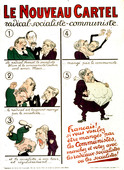
- Main issue : how the moderate Left can cooperate with the Marxist Left ? This well-known caricature from the days of the Front Populaire (1936) shows how the Right Wing saw the alliance between the Communists, the Socialists and the Radicals (who, contrary to their name, are on the Centre left of the political span) : first the Socialist eats the Radical and then the Communist eats the Socialist!
The whole term of Socialist president Francois Hollande (2012-2017) was jeopardized by the "frondeurs" (rebels) of his own majority who systematically opposed all his (modest) legislative attempts to help business (or damage it less than before)... Read more about the Right/Left split.
Credit
What's wrong with France?
Nobody seems to understand what's going on in this country these days. The economy is not doing well, unemployment is high, the political life seems depressingly inadequate and moreover, it looks like the French do not believe in their future : their mood is execrable.
The national press runs the same stories over and over and the international press makes fun of the ridiculous decisions or declarations our politicians make.
It would be easy to conclude once and for all : this country is going down the drain, this people has no future, let's forget France.
But let's try to go a little further!
- France is facing the same problems other European countries face and solutions exist
- France has certain weaknesses but real elements of strength
- The 2008 crisis has just worsened a situation which pre-existed since the 1970s
What makes the situation in France somewhat different from other countries could be some of the following reasons :
|
| To related pages : Money and politics, French sacred cows, French attitudes, irksome France, Europe, etc... |
|
To table
of contents
To top
of the page
Back to home
page
|
Harriet Welty
Rochefort writes articles and books about France and the French.
Order her books :
- "Joie de Vivre", Secrets of Wining, Dining and Romancing like the French, St.Martin's Press, New York, 2012
- "French Toast, An American in Paris
Celebrates The Maddening Mysteries of the French", St.Martin's Press,
New York, 1999
- "French Fried, The Culinary Capers
of An American in Paris", St.Martin's Press, New York, 2001
- "French
Toast - Heureuse comme une Américaine en France",
Ramsay, Paris 2005
More on Harriet's books (excerpts, upcoming
events, testimonials, etc..) |
| To
email
me |
Together
or separately, Harriet and Philippe speak
about Intercultural Difference: click
here for information.
|
|