|
| Education in France (#1) |
|
And also :
|
 |
|
|
|
|
|
|
| Some facts on education in France... |
|
Understanding the "Grandes
Ecoles"... |
|
Education in France is definitely
different from education in the US:
-
In
France, kids start school very early
: school starts at age 2 (for 52% of children) or 3 (it is mandatory at 3) and children spend 2 or 3 years in maternelle (kindergarten).
School is compulsory until age 16. In primary schools, French
kids spend more hours a year (almost 900, like Italy and the
Netherlands) than other European countries (less than 700 for
Austria, Germany and Finland) : in France, less days of school (vacations are a national value) and more hours per day. (see detailed figures) Contrary to a frequent American
stereotype, learning by rote does not exist or hardly (it was
true in the 19th century).
Read about parenting in France.
-
All
professors in public schools and universities are employed
and paid by the state. The Ministry of Education is, by
far, the largest employer in France and (it is said) the second
in the world (after the Red Army!) with more than one million employees. Writes Nadeau
: " An outstanding feature of French education is the
authority of teachers. The French don't regard childhood as an
age of innocence but see it as an age of ignorance. Children
must be set straight and corrected."
-
Most schools are public (85%) but there are also private schools
throughout France (particularly in the very religious regions
of Western and Eastern France). Separation of church and state
was decreed in 1905 but Catholic schools continue to coexist
alongside public ones - and get state funding for teachers salaries,
social security costs, and scholarships. 13.4 % of elementary
school children and 20% of high school pupils attend private
schools. See French schools abroad and the comparison with other European
countries.
-
High school : see the (new) program of French high schools and note that there are few options and few extra-curicular activities. The final exam, the "Baccalauréat"
or "Bac" is very important for French students
because it gives them access to university studies, with no further
selection. It is a rigorous exam with no multiple choice questions
: it includes a written part and an oral part, with several subjects
each. It lasts up to six days. Less than 20 per cent of those
who take it fail (and now many people think it's too easy) and it does not mean anything except it gives access to the university, even for people whose level and motivation are too low. Every year, the "bac"
is one of the major events of the month of June and newspapers
publish and discuss the subjects in Philosophy and Literature.
The French love it and refuse
to change it. More in Paris
Diary.
Due to Covid, the bac was practically purely symbolic in 2020 and 2021 (most subjects cancelled, success rate >90%) and there is hope that this archaic ritual will disappear in the near future.
-
France has a dual system
for higher education : "Universités"
and "Grandes Ecoles"; the latter (less than
5% of students) requires very competitive selection entry exams.
Click to understand the "Grandes Ecoles"
system, which concerns mostly science and business studies. For
medical and law studies, there are no Grandes Ecoles but universities
have developed selection systems in the course of the studies.
-
Education is almost free
at all levels (zero from kindergarden to high school, tuition around $400 a year at Sorbonne : read
below) except for private schools and business schools. 26% of
university students receive scholarships. But it is a fact that
French Universities do not offer as many services and facilities
as American universities and from this standpoint, only Grandes
Ecoles compare to the US system (an there, tuition represents a few thousand $).
Compared to the US, student loans are rather unfrequent in France (see numbers).
-
The grading system goes
from 0 to 20 with 20 being perfect. The grading system is extremely
tough. Hardly anyone ever gets a 20 or even an 18 or 19. Teachers
read the grades out loud when they hand back homework and tests.
School is hard on French children : read in Baudry
or in French Toast how
it can impact the entire personality of the French. An important
thing to know : in France, the grade you get is not aimed at
stimulating you to improve but to punish you so you react and
get better. This is why sometimes American universities are surprised
when the best French student (from the Grandes Ecoles) apply
when their grades in math are around 7 or 9 (a C- in France)
and, when admitted, get an A+ in the USA!
|
|
One of the most important facts to know to understand the country is that France
has a dual university system : the "Universités"
and the "Grandes Ecoles". Grandes Ecoles have
no equivalent in the USA.
| After High School,
some students (among the best) apply to be admitted to a "Classe
Préparatoire": these classes (located in some High Schools) prepare students
(in two or three years) for a very competitive admission test
to Ecoles d'Ingénieurs (Sciences), to Business
Schools or to a few other kinds of schools. In these classes,
students work like dogs (40 hours courses a week + constant tests
+ personal work, no week-end, etc..) to be admitted to the best
possible school. Actually, they work twice more than college students (see numbers). Contrary to what the NYT wrote,most of these preparatory classes are free (read more.) and students enjoy very good working conditions. |
|
Writes Nadeau
: ..."French parents don't want to send their children
to university. We could not believe this until we understood
just what the Grandes Ecoles were. French parents do everything
they can to make sure their child won't go to university but
will go to a Grande Ecole...." |
-
The "Grandes Ecoles" are not part
of the rest of the University system : they are smaller,
they have much more money (they get 30% of the national university
budget with only 4% of the students), they are kept apart from
the rest of the educational system, they are based on fierce
competition of the students among themselves and the schools
between themselves. The most prestigious schools give access
to the new French nobility : the "Grands Corps". Their
graduates will always be the boss !
-
"Grandes écoles"
are close to the labor market and, contrary to the universities,
their graduates have little (if any) problem to find a job.
-
The tuition is almost nothing
(except in Business Schools where it is around $8 to 10,000 /year). In some cases (Ecole Polytechnique, Ecole Nationale d'Administration,
Ecole Normale Supérieure), the students are paid a
salary (around Euro 2,000 a month). There are many Grandes Ecoles
(around 250) but they are very small ; the largest (Polytechnique,
HEC, Centrale, Arts et Métiers, INSA,..) have around
one thousand students each. The number of students in the Grandes
Ecoles represents only a few % (around 5%) of the total number
of students.
-
In a nutshell : here is the
comparative cursus in Universities and Grandes Ecoles
:
|
University
Grandes Ecoles |
DEUG1 |
DEUG2 |
Licence
L3 |
Maitrise
M1 |
Master: DEA or DESS |
Doctorat |
| Year 1 |
Year 2 |
Year 3 |
Year 4 |
Year 5 |
etc.... |
| Classe
prép.1 |
Classe
prép.2 |
First
Year |
Second
Year |
Third
Year |
Doctorat |
|
This organisation in 5 years
is common to all European countries. It is called LMD (for "Licence,
Maitrise, Doctorat"), with Licence in 3 years, Maitrise
in two years and then Doctorat.
Expenses for Education. Regarding university students, and in terms of expenses, a few comparative figures illustrate how France compares with other countries :
- close to Germany, in the upper part of the European bracket, much less than the USA
- much less private funding for universirties and for R&D than in the USA
- more public money for the most selective cursus.
- The most prestigious Grandes
Ecoles are Ecole Polytechnique (called "X"), Ecole Normale Supérieure ("Normale Sup")
and Ecole Nationale d'Administration ("ENA",
a post-graduate college), whose initial missions are to train
respectively military engineers, university professors and high
ranking state officials. They are followed by Hautes Etudes
Commerciales (HEC), Ecole des Mines, Ecole Centrale, Institut d'Etudes Politiques, etc...
DID YOU KNOW THAT....? Most French kids buy a cahier de vacances for their summer vacation (more than 4 million a year are sold). They find exercices to make sure they understood the program of the previous school year and others to prepare them for the year to come? Aren't the French more serious than you think ? |
-
Schools do not sponsor extra-curricular
activities, or hardly any. The only thing that goes on at school
is....schoolwork. This is a major difference with the US system.
French universities have much less money than US universities
and therefore offer much less activities to the students.
-
All
French students study Philosophy in their last year of
high school. France is one of the few European countries (with
Spain, Italy and Portugal) which requires this. Questions for
a 4-hour dissertation in 2003 : "Is dialog the path to truth
?", "Why are we sensitive to beauty?", "Is
happiness a private matter?". Paris has many cafés
where people discuss philosophical topics, with the help of a
moderator.
-
Math is the yardstick by which performance is measured. Even
though a student may be of a literary bent, he or she will probably
choose the "Bac S" (the math "bac") because
it is seen as the best. The good side of it is that a quite high
proportion of great mathematicians are French (10 Fields
Medal winners out of 44) and math is still one of the domains where
France can challenge
the USA !
However, things have changed dramatically in the past 20 years or so and the level of math of French students has decreased significantly at all levels. Why ? Read a tentative explanation .
-
French high school teachers
are not in school all day long. They come to give their courses
and then leave. They do not have office hours. In French schools
it is common for teachers to tell children they are nuls
(zeroes). This may become a thing of the past as the French come
to grips with the problem of battered and abused children. Some
psychologists and children's defenders are now making the link
between negative treatment at school and child development.
-
The
" collège unique " is an excellent example
of France's rather dogmatic policies (in France, " collège
" is junior high school) : in the 1970s, it was decided
(Loi Haby) that all children in French high schools should be
in the same classes whatever their respective level : you cannot
have classes composed solely of children with learning problems,
or immigrant children just arrived from their country, or particularly
intelligent students, etc.. All classes must be mixed. The reason
: priority to equality.
The consequence : serious problems with classes, particularly
in neighborhoods where the number of immigrants is high and their
knowledge of French insufficient. In spite or because of the
wish for equality, this law results in inequality. This is re-inforced
by the "carte scolaire" : until an minor attenuation to the rule by N.Sarkozy, you must send your children
to a school in the zone where you live. Thousands of parents
do everything they can to escape this regulation (including renting
a phony residence next to a better school).
-
In France, most schools are
given the name of an illustrious personality. The decision
is made by the local authorities on a proposal made by the teaching
staff. It is interesting to see the names of the people the French
think represent best their educational system. The most popular,
with hundred of schools named after them, are Jules
Ferry, Jacques Prévert, Jean
Jaures, Jean Moulin,
Jean de La Fontaine,
Antoine de Saint-Exupéry, Jean
Monnet, Pierre et/ou Marie Curie. Click on the names for
more details and here for statistics
about the names of schools.
|
|
- France is practically
run by people who graduated from two of the "grandes écoles", X or ENA (sometimes both)
:
the President of France, and generally the Prime Minister,
most of the cabinet members, most CEO of major companies (more
than 30 out of the 40 companies of CAC-40, the index of
the Paris Stock Exchange).
ENA (Ecole Nationale d'Administration) was created after WW2 to |
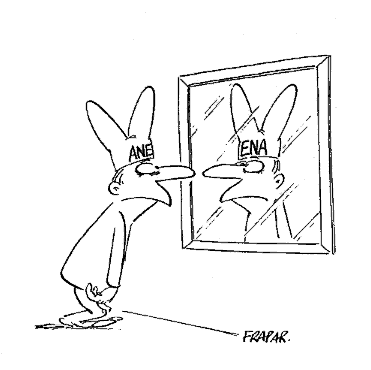
A callous pun about ENA... (credit) (the joke is that ANE means "ass") |
ensure a democratic recruitment of top ranking civil servants.
As of today, it has become an aristocracy in itself. Around 100 students graduate every year. Read a few quotes about ENA. |
-
The Grands Corps : at the end of the studies at X (Ecole
Polytechnique), there is a ranking and the students choose
an "Ecole d'Application" (the first ten or so : Ecole
des Mines, the next fifteen of so : Ecole des Ponts &
Chaussées, etc...) ; at the end of ENA, same thing
: first ten or so : Inspection des Finances, then Conseil
d'Etat, etc.... Then, for the rest of their carreer, the
best students belong to one of these powerful "Grands
Corps" (literally : great bodies) : Corps des Mines (X
+ Ecole des Mines), Inspection des Finances (ENA), Corps des
Ponts (X + Ecole des Ponts et Chaussées), Cour des Comptes
(ENA). A "Corps" is a sort of association, in charge
of managing the career of its members, in competition with the
other "Corps" (once you're in a "Corps",
the rest of the world does not exist...).
To understand France, it is essential to know that, in this country, the political and economic power is largely in the hands of the members of the "grands corps".
-
In some countries, the most prestigious positions go to lawyers, in others to scientists, historians or architects : in France, most of the leading
positions are occupied by people with an engineering degree,
very often civil servants or former civil servants, members of
a "Grand Corps" ! Read about working
with the French and politics
and see the detailed figures
in 2008.
-
Some of the best French "grandes écoles" have been successfully duplicated in China : read more.
-
More to come
DID YOU KNOW THAT....? In France, if someone says
he/she is an "ingénieur", it does NOT
mean he/she can fix your car. An "ingénieur"
is not an "engineer". It means that he/she studied
in one of the "Grandes Ecoles" and it is quite prestigious.
If it's one of the best of these schools, it is very likely that
he/she is incapable of fixing your car but that, after having
succeeded in a very competitive academic cursus and reaching a high-level scientific education, he/she is a
manager in a good-to-high position. The French have very subtle
codes to make you figure out which school they went to.
An illustration (from my personal experience) : regularly, I give face-to-face intercultural training sessions to top-level American managers recently assigned to France by their US company. The first question I ask them is :"Do you you know where each member of your executive board is a graduate ?". The answer is always :"Who cares. They are experienced professionals and I do not need to know which exam they passed twenty years ago!". A major intercutural mistake : the members of your staff expect you to understand the very strong culture and implicit hierarchy that they all share. |
-
The Erasmus program allows European students to study for up to a year in
another European country for full credit and at no extra cost.
-
In France, it is much more frequent
than in the USA to repeat a year (by far the highest rate of OECD countries : at the end of High School, 17% of the kids have repeated at least once) : if you do not adjust
to a class and if your grades are not good enough, you have to
do it again...
-
Click here for a very detailed chart of the French educational system, from First Grade to College.
- Click here to see how French High Schools teach economics.
|
|
DID YOU KNOW THAT .....
? Almost all three-year-olds go to school; approximately
35% start at age two ; "la maternelle", which consists
of the 3 years before primary school, is very largely attended
in France. It would, in fact, be hard to imagine a four-year-old
French child not attending school! "Overall, 98% of children
between 3 and 5 are in school in France", writes James Corbett
in "Through French Windows". This compares to
50% in the U.S. Since our children attended French schools all
the way through, starting at the tender ages of two and three,
we can testify that, far from being traumatized as my wife thought
they might be, they loved every minute of it!
-
In France, education includes learning about food and eating habits : see what they eat in Primary schools.
- AAWE is an association of expat US women in France : to know more about Education in France, the best sources is AAWE Guide to Education
More to come....
|
| Clouds over the French
university system ! |
|
Why a dual system ? |
|
The French system is more and more criticized. A report by two prominent French
economists (Ph.Aghion & E.Cohen, 2004) lists six reasons
of what it is not exaggerated to call a very serious crisis :
-
Students are neglected :
financially speaking, the French system has privileged high schools
versus universities : in 2000, the ratio of expenses per university
student/high schools student is the lowest in developed countries
:
Sweden : 2,4
USA : 2,3
Japan : 1,7
UK : 1,6 |
Germany : 1,6
Spain : 1,3
Italy : 1,1
France : 1,1 |
-
Decline of universities :
more and more students (2,7 million in 2018) but more and more
in the Grandes Ecoles and in the shorter
education cursus ; the dual system cannot address the new issues,
since the Grandes Ecoles are too small and too specialized and
short cursus do not contribute enough to research
-
A failure of the mass educational system :
too many drop-outs and people who did not get any degree : every
year 90,000 out of 750,000 ; as a result, the vision of the future
of young French people is one of the most negative among advanced
countries (see a comparative
poll)
-
A serious loss of prestige for French
universities : in spite of their 12% of foreign students
(rank 2 in Europe after UK) , the French universities no longer
attract the best students from the whole world; the recent ranking
made by the University of Shanghai of the 500 best universities
of the world is awful for the French national pride (the best
one ranks 65th) : the good teaching and research centers are
too small, and the big universities are not good enough ;
-
The competition from US universities :
more prestige, more research and more services attract the best
students and give them a better preparation ; in the US, the
student/teacher ratio is similar to France (around 9) but the student/(service and technical staff) ratio is 3, compared to
40 in France (!!) ;
-
Lack of money : the cost of a student at the Sorbonne
is 33 times less than the cost of student at Princeton. As J.R.Pitte,
the former president of the Sorbonne, jokingly emphasized, each student
has an average of 2,6 sq. meters (24 sq. ft) when a "poulet
de Bresse" (a high quality chicken, with the AOC
label) demands 90 sq. ft. to keep the precious label !
-
not enough preparation for active life (except
in "Grandes Ecoles")
Some recent changes ....
The French educational system must change to face serious challenges :
-
Since 2008 (LRU Law), universities can become "autonomes" : more budgetary autonomy, more flexibility to appoint professors, possibility to raise money through private foundations. Most of them did, but some of them (including the Sorbonne) turned down this opportunity. To understand why, read my "Diary of an old student"
-
Since 2004, universities can become a "grand établissement", a status between university and grande école (already the status of Institut d'Etudes Politiques). One of the best French universities, Paris-Dauphine, did.
-
Universities are encouraged to create joint structures (called PRES) among themselves and Grandes Ecoles, to benefit from the quality of research in universities and the quality of management in Grandes Ecoles. A "Plan Campus" has been launched to improve the quality of French campuses, etc...
IN A NUTSHELL..... French universities are changing dramatically but don't mention it : in France, changing is not a positive value and major evolutions are always subreptitious. But I bet that in ten years most of the most absurd aspects described above will have disappeared. |
|
France is the only country with such
a system for Universities. Why ?
-
A " Grande Ecole "
was created everytime the need for specialists could not be satisfied
by universities. From the mid-XVIIIth Century : to build harbours and bridges ("Ecole
des des Ponts et Chaussées" as early as 1747), to
improve artillery ("Ecole Polytechnique"), to exploit
mines ("Ecoles des Mines"), to develop industry ("Ecoles
Centrales" and "Ecoles des Arts et Métiers"),
to train managers ("Ecoles de Commerce"), etc..
-
Meanwhile, in the rest of the
world, universities created their engineering and their business
departments
-
The inability of French University
to reform is not recent
: King François Irst founded the "Collège
de France" in 1530 to host disciplines which were rejected
by the university. Five centuries later, it is still one of the
most prestigious research centers in the country, and it is not
an university.
-
Common wisdom say that Grandes Ecoles get the best students while Universities get the best professors.
-
In a nutshell, today's French
system includes three kinds of entities :
-
84 Universities : free, no selection, no money, no connexion
with the job market, too crowded, cut off from the real world;
-
Around 250 Grandes Ecoles : generally free, most very selective,
adequately funded, well adapted to the job market, not enough
research, too small, the best of them forming a new aristocracy;
-
A handful of large state
research organizations (CNRS, INSERM, CEA, etc) : forming
joint teams with universities and Grandes Ecoles but often too
bureaucratic and too cut off from the economic world.
The Shanghaï trauma
-
With the criteria of the University of
Shanghai, the ranking of French universities is very disappointing
: only 4 in the first 100 universities in the world. Apart the true fact that the French educational system does need to be improved, some of the main reasons for this poor ranking are the critera of the ranking and some specificities of the French organization (see below).
-
The detailed ranking for French
universities is : Paris VI, Paris XI, Strasbourg I, Ecole Normale
Supérieure Paris, Collège de France, Grenoble I,
Paris VII, Toulouse III, Montpellier II, Bordeaux I, Bordeaux
II, Ecole Polytechnique, Lyon I, Paris V, Ecole Normale Supérieure
Lyon, Aix-Marseille II, Ecole de Chimie Paris, Aix-Marseille
I, Nancy I, Ecole des Mines Paris, Clermont-Ferrand, Nice.
-
In
France, research organizations are OUTSIDE the university. As shown on this page, the French system
must be improved but still this Shanghaï ranking is adapted
to American-type universities. It favors the number of publications
in English - speaking reviews and the number of Nobel prizes ;
French universities are smaller and French-public research is
largely done in public agencies (Centre National de la Recherche
Scientifique CNRS, Institut National de la Santé
et de la Recherche Médicale INSERM, INRIA for computer
science, etc..) which do not belong to French Universities although
many labs are common. For instance, two of the three last French Nobel
Prizes (Chauvin, Chemistry, 2005 and Fert, Physics, 2007) do
their research at CNRS and will not contribute to improve the
Shanghaï ranking of any university! See the detailed
ranking of French research institutions : it must be improved
but it is not as bad as the Shanghai ranking might suggest !
-
The only field in which a French
university is the world leader is Mathematics (Paris-6
is #1 and Paris-11 is #13). Read why the French are good in maths.
-
According to an American study (2016), the ranking of colleges and universities based on the number of Nobel prizes per 10,000 alumni shows a dominations of US institutions but a surprisingly good ranking of the best French Grandes Ecoles (Ecole Normale Superieure #1 and Ecole Polytechnique #6). See more details.
-
A good book by a former head of Ecole Normale Superieure, who proposes to merge the two systems into a new kind of university : Monique Canto-Sperber, L'oligarchie de l'excellence, Presses Universitaires de France, 2017, 348 p.
-
More about the most prestigious French research centers
|
-
More money is poured into the university system (the "Grand Emprunt" representing an additional 11 billion Euros in 2010) but, more interestingly, for the first time only to the best and not "money for everyone" as before
-
All cursus are now adapted to the (new) European format, called LMD (L for "licence", M for "Maitrise", D for Doctorat). Programs are divided in semesters (6 for a "licence", plus 4 for a "Maitrise", i.e. 5 years), and most "unités de valeur" are (or will be) pooled among all European universities, in order to encourage students to accomplish part of their cursus in a foreign university.
-
Foreign students :
there is a global competition to attract the best students and
American universities are
leaders but French universities are trying to catch up, with
programs such EduFrance. The visa policy is loosened (after the
stupid anti-immigration policy of the early 1990s with the Pasqua
law) and more students come from Eastern Europe and Asia (multiplied by 10
between 1996 and 2003 for Chinese students). Meanwhile, the number
of foreign students in the USA dropped dramatically after 9-11.
-
Conclusion : there is now (2014) some Good News about universities.
|
|
DID YOU KNOW THAT.....? In France, there
is NO selection at all to be admitted to college. Contrary
to "grandes écoles" (see above), anybody having
passed the "baccalaureat" exam is entitled to be admitted
to any university. This is of course absurd and it explains why
French universities are over-crowded (at least for the first
two years) with a rate of drop-out of 50% or more, the worst
being Medical School where only one student out of five passes
the first year exam. The project of setting up a selection process
for admission to universities is one of these ever-lasting controversial
ones the French cherish : the right wing is for it and the left
wing strongly against (in the name of equality and democracy). Young
students, who are not helped in their orientation, are the primary
victims and nothing changes....The President of the university
recently mentioned in an article the drop-out rate at the Sorbonne : 73% the first year,
47% the second year, 42% the third year. In medical schools, 85% of the students fail their first year. This is the price of
the myth of "No selection" Read more about the French sacred cows : no-selection is one of them.
The webmaster'sview : in September
2005, a new student enrolled at the Sorbonne : ME ! Read the Webmaster's diary of an old student for an
insider's view of the French educational system. |
To related
pages : more on education (#2), main issues for education (#3), French attitudes, French issues, intercultural differences, try my French Quiz, learning French, etc... |
|
To table
of contents
To top of the page
Back to home
page
|
Read Harriet’s views on Education in French Toast :
. . . school is based on work and not extra-curricular activities, . . . my kids didn’t star on the basketball team, because there wasn’t one. Ditto for band . . .They will, though, have received a complete education in terms of knowledge. And, hey, they have the rest of their lives to develop their personalities. That, definitely, is not the job of the French public school.
For more on inttercultural differences, order Harriet Welty Rochefort's books : Joie de Vivre. Secrets of Wining, Dining and Romancing like the French, St.Martin's, 2012, French Toast.An American in Paris Celebrates The Maddening Mysteries of the French, St.Martin's Press, 1999, French Fried. The Culinary Capers of an American in Paris, St.Martin's Press, 2001. More on Harriet's books (excerpts, upcoming events, testimonials, etc). |
Together
or separately, Harriet and Philippe speak
about Intercultural Differences : click here for information. |
| To
email
me |
This page is one of the 10 most visited pages of the site. If you like this site, please bookmark it or create
a link! |
|